
 THE INTENT LAYER
What the club intends.
Blueprint is not a fifth tool. It is the layer the tools stand on: one place for what your club believes, how it teaches it, and what it is working on this season, read by the review, the training week and the match plan alike.
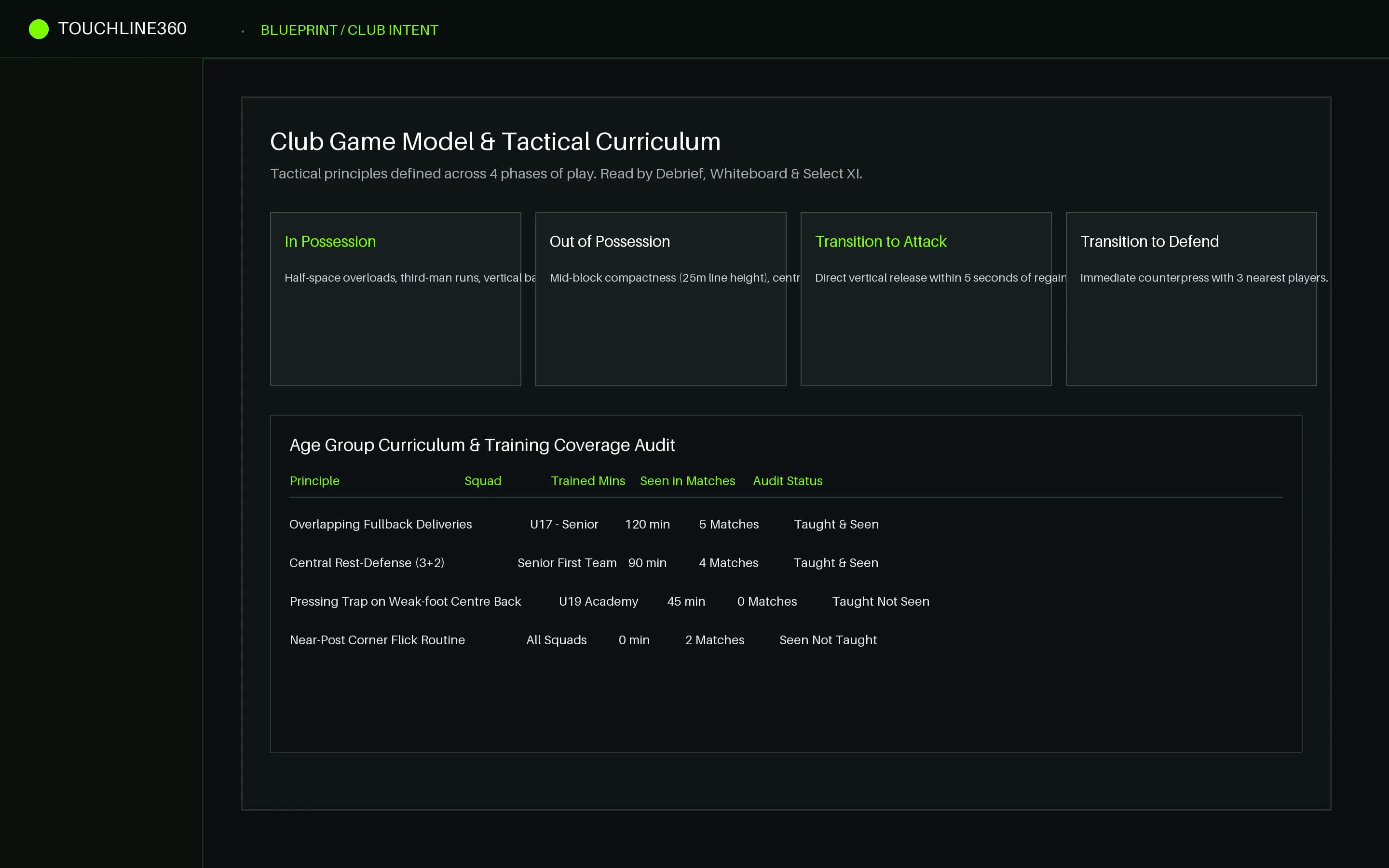
The game model
What the club believes about each phase of play, written as principles. Every finding in a match review is measured against these, not against a league average.
The curriculum
How those principles are taught, age group by age group and phase by phase. An empty cell in the grid is the point: it is a gap somebody should see.
Coverage
Whether each principle was actually trained this month and actually seen in a match. Taught and seen, taught but not seen, seen but never taught: the three answers a director of football wants.
Why a layer and not a product
A club’s intent was already in the suite three times over: principles in the game model, priorities in the training week, and a curriculum by age group. That is one thing wearing three names, and a coach had to keep them in step by hand. Blueprint owns all three, so a principle written once is the same principle the review measures, the session teaches and the report counts.
What it changes downstream
- Debrief compares what you intended with what happened, because the intent is a thing it can read.
- Whiteboard plans a week against the gap, not against a blank page.
- Select XI carries the same principles into the match plan.
- PlayerPath can say which objective a player is working on and which principle it serves.
Where it actually is
Blueprint runs inside the app today, as one workspace: Overview, Game Model, Curriculum, Team Priorities, Coverage and Changes together, not separate screens. A club adopts one team’s game model and curriculum as the club plan; adoption walks every conflicting principle and unit and requires an explicit choice or acknowledgement for each one, so nothing is merged or overwritten silently. Owners and club admins publish changes directly; a coach can instead propose a change with a reason, for an owner to accept or reject from a before/after view. Once published, the same principle carries into a planned training session, a team priority, a match plan and a Debrief review, because every one of those reads the published plan rather than its own copy. Coverage reports planned and completed training minutes separately, and every row links back to the sessions, curriculum units and dated match evidence it came from — it never says a principle was trained or seen without that record behind it.