
 THE REVIEW LOOP
Your match. Your game model. Your next training session.
Debrief is the post-match workspace for a club that films its own games. Saturday’s footage goes in. Findings you have decided on, a film session for the players and the week’s training come out, and every claim points back at the moment it came from.

The whole loop, in one sitting
Silent, with the captions on screen, so it plays on a phone in a clubhouse with the sound off.
Below it, the same loop screen by screen.
Step 01 · Match in
Put the match in
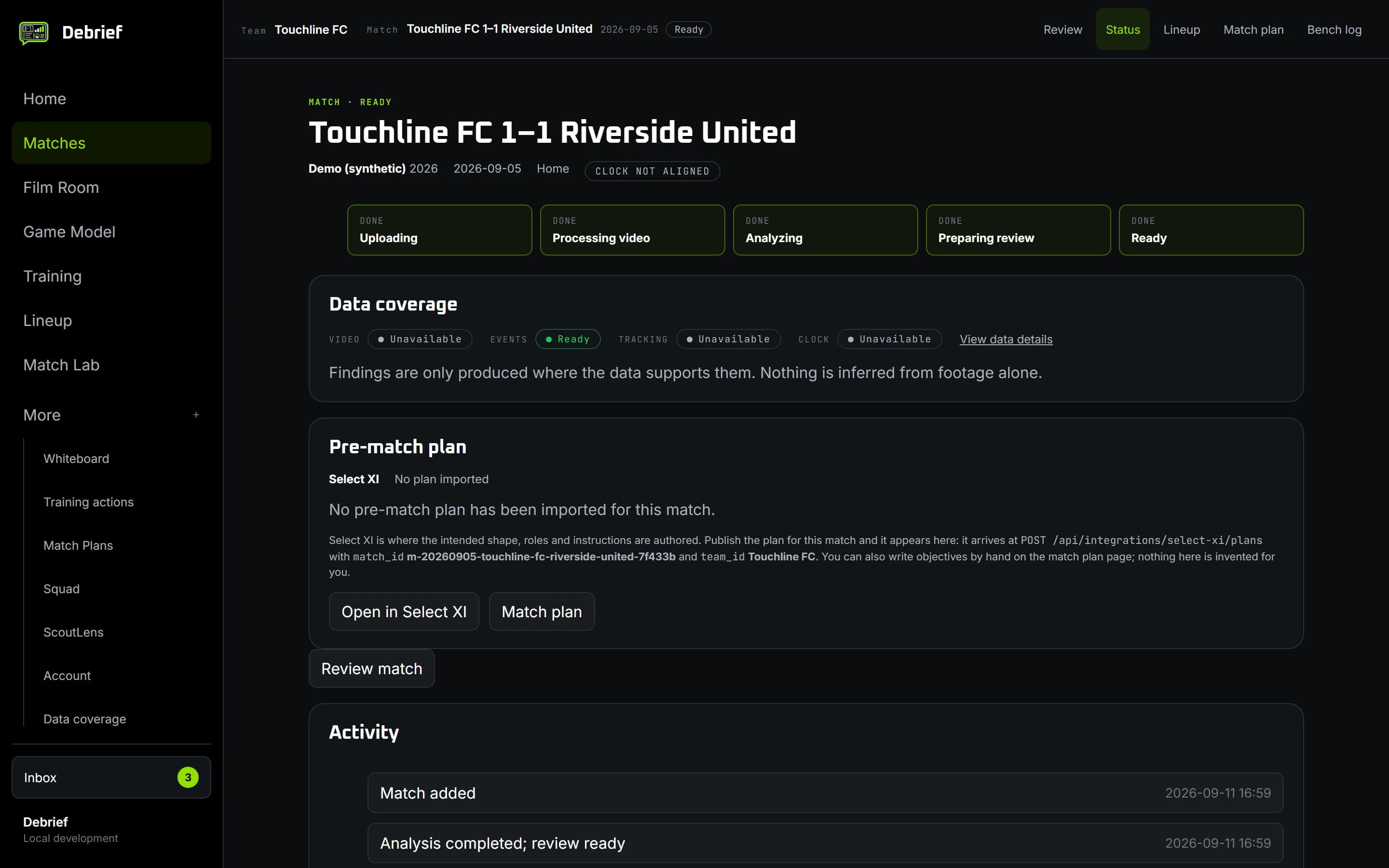
Upload the footage you already film. A camera on a tripod, a phone, or a Veo feed is enough. Add the teams, the score, the competition and the lineup, and Debrief stores the video privately for your organization and prepares it for review.
The match page then says what the analysis can support before you spend an evening on it: what was uploaded, what was processed, and what is missing. A finding that would need an event feed says so rather than guessing.
- Your team and the opponent, venue, competition, season, date and score.
- Starters and substitutes, one per line.
- The video, kept for your organization and nobody else.

Step 02 · Findings
Decide what the match found
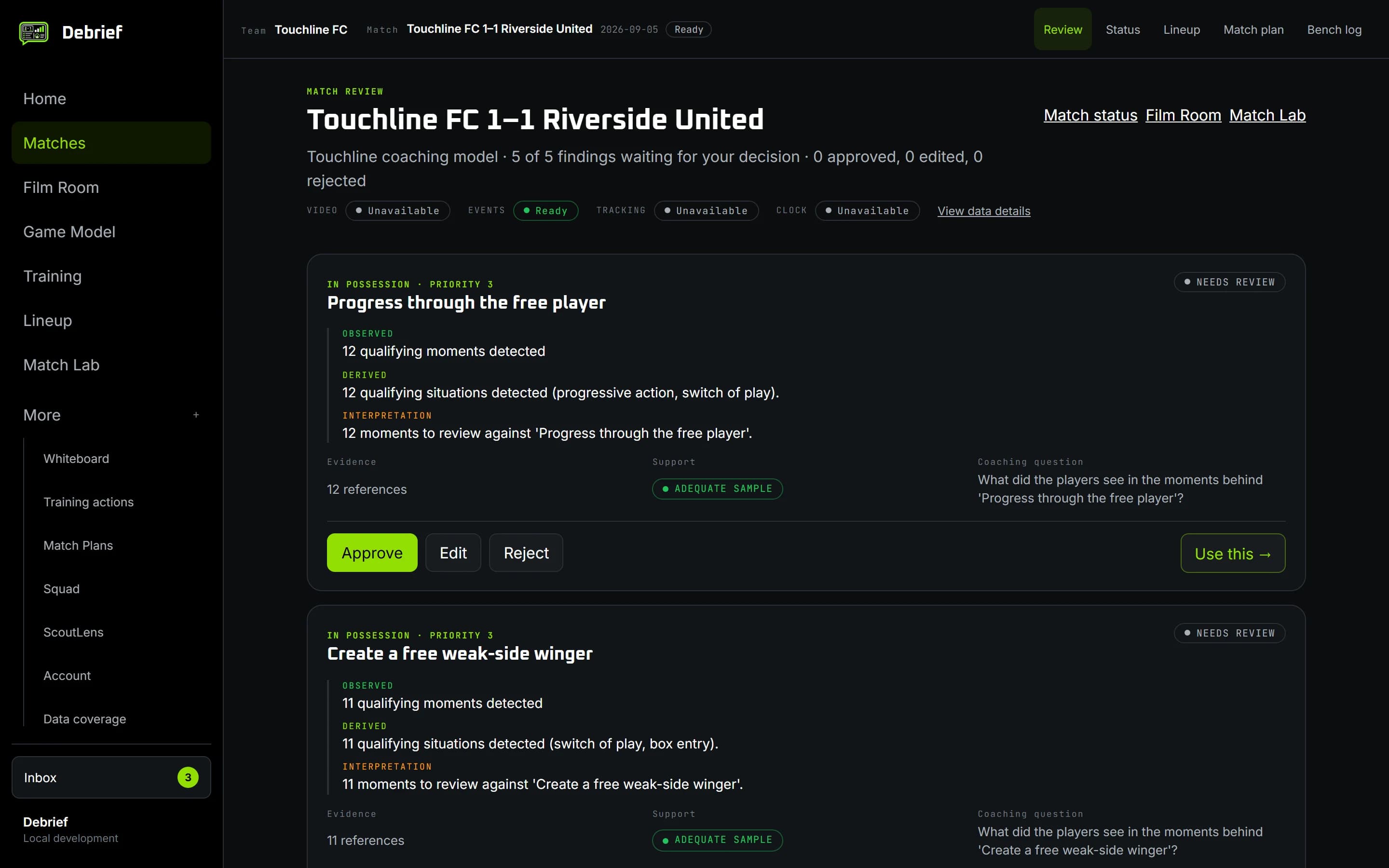
Debrief reads the match against your Game Model and proposes a finding for each principle: what it observed, how many references sit behind it, and the coaching question it raises.
Nothing travels into the week that you have not decided on. Approve a finding, edit the wording until it sounds like you, or reject it. Principles without enough evidence are kept separately and say so; they are never padded out to fill a page.
Use this then sends a finding on: into the Film Room draft for this match, into a training action for the week, onto the next match plan, to an objective for one player, or onto a watch list that resolves after the next match as improved, unchanged, regressed, or still short of evidence.


Step 03 · Film session
Build the film session
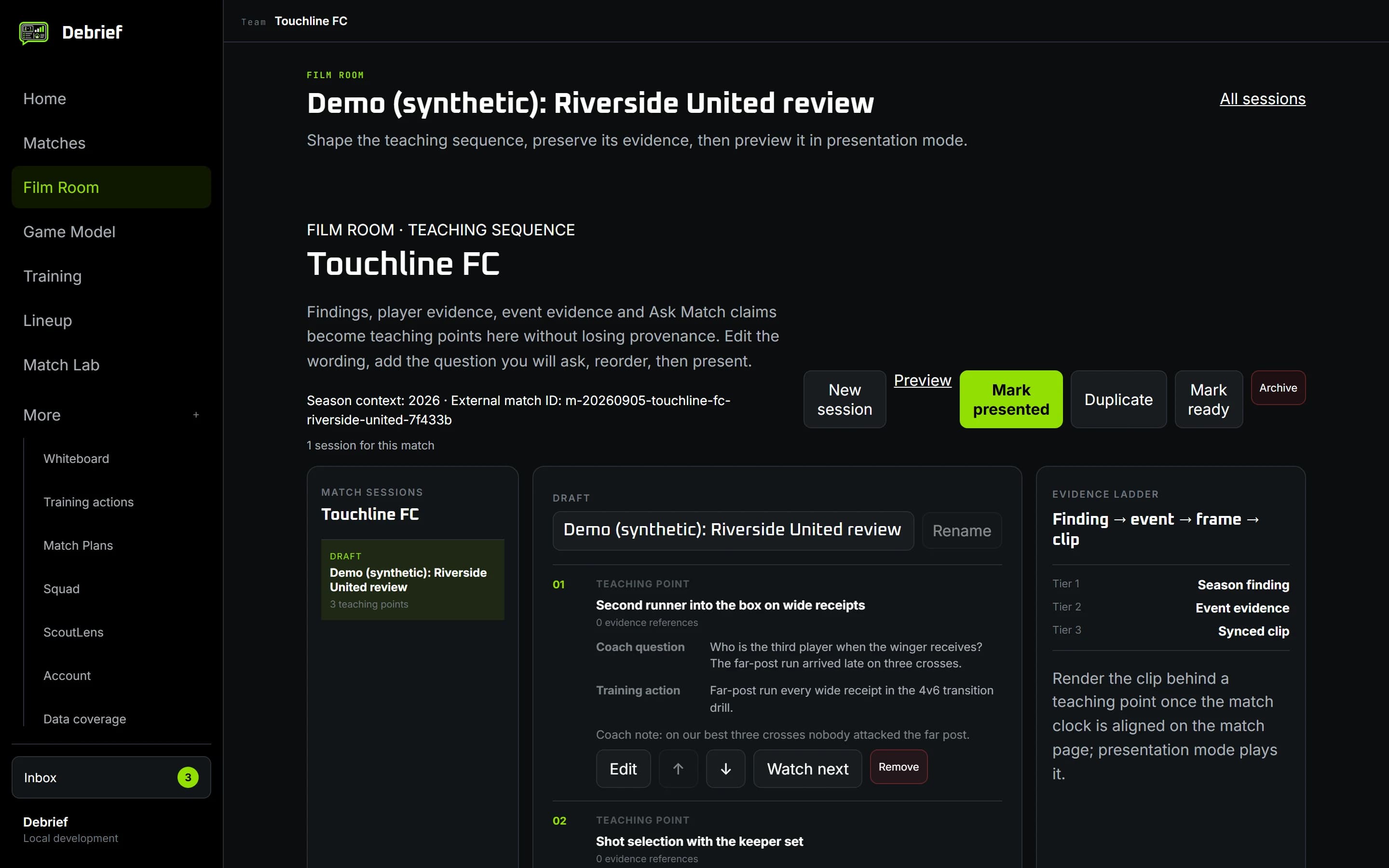
Findings you approved arrive in the Film Room as a draft for that match. Order the teaching points, cut the ones that will not land, and write what you want the players to see and the question you will ask them about it.
Each point keeps the evidence it came from, whether that is event evidence, season evidence, player evidence or your own teaching point, and the label above it says which. A note you wrote never wears the clothes of a measurement.
Step 04 · Presentation
Present it to the players
Presentation mode is one teaching point per screen: the clip first, then the point and the question, and nothing else on the wall. Arrow keys, Space and the page keys move; Home and End jump; Q shows the question; F fills the screen.
The evidence badge stays in the top bar on every slide, so nobody in the room mistakes a coach’s note for a measured finding. Marking the session presented closes the loop: the match, the findings you kept, and the session the players actually saw are all one record.


What you need to start
A team that films its matches, and one sign-in for your club. No tracking data, no data provider and no event feed are required. Where a finding would need one, Debrief says so instead of inventing it.
Matches, the Game Model, findings, film sessions and training plans belong to your organization. No other club can see them, and a training plan shared with players is a link you can revoke.